
= “Building Standards”;
$description = “Assessment techniques and rating methods are necessary to enable the environmental effects of urban or building schemes to be demonstrated or compared.”;
$subject = “Business”;
chapter 3: Building Standards
“Assessment techniques and rating methods are necessary to enable the environmental effects of urban or building schemes to be demonstrated or compared. The use of these techniques permits planning authorities to choose from options, set targets and establish goals. Assessment methods and techniques are therefore an essential part of the system that is required to enable sustainable development to take place in a more measured and accurate way"1
Having established the concept of zero carbon homes and their ground in the UK climate, emphasis should now be paid on the validation of a zero carbon home. This chapter deals with this validation process by discussing various building standards (also known as assessment methodologies) which determines the sustainability level of a home. Since the research is based in the UK, the Code for Sustainable Homes, which is the assessment methodology referred for the building constructed within the UK, will be studied in detail. The study will be based to find out the criterion which needs to be fulfilled to achieve zero carbon status.
The consciousness of what impact the activities of the building sector is having on the environment happened some twenty years ago. Some considerable changes were needed to tone down the environmental impact of building sector. Emphasis had to be paid on how the buildings were designed, built and operated. Public policies and growing market demand for environmentally sound products and services were the major drivers. When aiming to reduce environmental impacts, a yardstick for measuring environmental performance was needed.2 The first real attempt to assess several environmental considerations in buildings simultaneously were proposed by the Building Research Establishment Environmental Assessment Method (BREEAM).3 Since then many environmental tools have been launched around the world. Assessments can vary from simple checklists or ranking of construction materials to sophisticated models. Complication here does not necessarily mean better. A number of factors resolve which is the best assessment or tool appropriate for the project. These factors are –
- Indicators considered
- The inputs the methodology uses
- The outputs (the type of results)
- The creator of the methodology
- Who the assessor is to be
- The scope of the assessment
- The building type it is intended for.
In the UK scenario, the drive to reduce carbon emissions has resulted in an overabundance of standards and assessment systems for determining the environmental impact of both domestic and non domestic buildings. Some are carbon focused and some have a wider sustainability remit. The following sections will give an overview of some of these assessment systems which may currently be encountered in the UK.
- BREEAM
Building Research Establishment Environment Assessment Method (BREEAM) is the principle method used to assess the environment impact of a building and was developed by the Building Research Establishment (BRE).4 It is used to measure both new and existing developments. It works on a points (or credit) system which assesses the following areas:
- Management of site and operational procedures
- Energy use
- Health and Well Being
- Pollution
- Transport
- Land use
- Ecology
- Materials
- Water usage
The performance of each building is assessed based on the above areas and a weighed score is then awarded. The scoring system is as follows – Pass, Good, Very Good and Excellent. There are several different versions of BREEAM and the exact number of points needed to achieve a particular category varies. For example, for most forms of BREEAM a building must score 40 points to achieve a Good rating but the management operation assessment of offices requires 35 points to achieve a Good rating. This is because the users of offices typically do not control the procurement and construction.
- EcoHomes
EcoHomes assessment is a specialised variant of the BREEAM procedure designed for use in domestic properties. It measures houses as well as apartment buildings and is applied for both new and renovated homes.5 The EcoHomes assessment was replaced in April 2007 with the Code for Sustainable Homes, however buildings built and polices created prior to April 2007 will use EcoHomes. An Ecohomes assessment consists of 7 categories which are identified by a three letter code:
- Energy (Eng)
- Transport (Tra)
- Pollution (Pol)
- Materials (Mat)
- Water usage (Wat)
- Land Use and Ecology (Eco)
- Health and wellbeing (Hel)
Each of these categories is divided into sections, and points are awarded for conformity with the various specifications in each section. The total possible number of available points is 100 and the scoring system is as follows:
- 36 points = Pass
- 38 points = Good
- 60 Points = Very Good
- 70 Points – Excellent
Essentially, the higher the Ecohomes score, the lower the environmental impact of a building.
- Sap: standard assessment procedure
This is the standardised methodology for assessing the energy performance of a building. It is used to calculate the energy consumption per square foot, energy cost ratings, environmental impact and CO2 emissions.6 The SAP categories produce scores which are aggregated to produce a value between 1 and 100. The higher the score, the more energy efficient is the building. SAP scores are used to determine compliance with Part L1A7 and Part L1B8 of the Building Regulations. The calculation is based on the energy balance, taking into account a range of factors that contribute to energy efficiency9:
- Materials used for construction of the dwelling
- Thermal insulation of the building fabric
- Ventilation characteristics of the dwelling and ventilation equipment
- Efficiency and control of the heating system
- Solar gains through openings of the dwelling
- The fuel used to provide space and water heating, ventilation and lighting
- Renewable energy technologies.
The method of calculating the energy performance and the ratings is set out in the form of a worksheet, accompanied by a series of tables.
- Code for sustainable homes
The Code for Sustainable Homes (CfSH) system was introduced in April 2007 to replace Ecohomes. It also works on a points based system in the same way as BREEAM and Ecohomes, but it uses different categories10:
- Energy and CO2 Emissions
- Water usage
- Materials
- Surface Water Run-off
- Waste
- Pollution
- Health and Wellbeing
- Management
- Ecology
Unlike Ecohomes, the CfSH applies mandatory minimum standards for each of the categories. A CfSH assessment awards a rating between one and six. Level one is considered analogous to BREEAM pass. Levels two and three are equal to BREEAM Good and Excellent. Level four is current standard of Best Practice (BREEAM excellent). Level six is an ambitious level, in that it is above what is considered exemplary performance. The CfSH rating system is shown below:
- Level 1: 36 points
- Level 2: 48 points
- Level 3: 57 points
- Level 4: 68 points
- Level 5: 84 points
- Level 6: 90 points
The CfSH is heavily slanted towards energy efficiency as 36.4% of all points are available in the field of energy reduction. 14% of points can be gained by producing a building that promotes health and well being (interior light levels etc.) and 10% can be gained by managing the build properly. The CfSH is a two stage assessment process in which the final operational building is assessed as well as the designs and construction.
LIST OF FIGURES
Figure 1: Image showing effect of climate change on earth (http://askehbl.files.wordpress.com/2009/06/climate-change1.jpg)

Figure 2: Government’s preferred hierarchy (HM Government, Definition of Zero Carbon Homes and Non Domestic Buildings – Consultation, December 2008)
Figure 3: Allowable Solutions (Zero Carbon Hub, Defining Zero Carbon Homes- ‘Have your say’ report 2009, April 2009)
Figure 4: Typical annual carbon dioxide emissions from a semi-detached house constructed to current AD L1A, 2006 (NHBC Foundation and Zero Carbon Hub, Zero carbon homes – an introductory guide for house builders, February 2009)
Figure 5: Breakdown of carbon dioxide emissions from regulated energy use (Stephen Ward, Faber Maunsell, AECOM, Carbon Neutral Buildings – The “what" and the “How")
Figure 6: Biomass Boiler (http://www.architectsjournal.co.uk/pictures/595xAny/9/8/9/1202989_Baxi_Multiheat_line_dwg.jpg)
Figure 7: Micro CHP (http://news.cnet.com/i/ne/p/2007/MicroCHP-1_550x423.jpg)
Figure 8: Ground Source Heat pump in a house (http://www.acclimatize.co.uk/images/ground-source-heat-pump.jpg)
Figure 9: Residential Photovoltaic System (http://www.deckerhomes.com/images/image_solarPVsystem.jpg)
Figure 10: Solar Water Heating Circuit (http://www.petervaldivia.com/technology/energy/image/solar/Solar-Water-Heating-Diagram.gif)
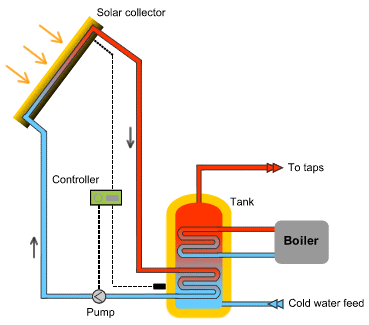
Figure 11: Home Wind Turbine (http://www.energymonster.co.uk/uploaded_images/home-wind-turbine-773371.jpg)
1 Adrian Pitts, Planning and Design Strategies for Sustainability and profit, 2004
2 Crawley D, Aho I, Building environmental assessment methods: applications and development trends, Build Res Inf 1999;27:300-8.
3 Crawley D, Aho I, Building environmental assessment methods: applications and development trends, Build Res Inf 1999;27:300-8.
4 www.breeam.org
5 www.bre.co.uk
6 www.bre.co.uk/sap2005
7 Office of the Deputy Prime Minister, The Building Regulation 2000 – L1A Conservation of fuel and power in new dwellings, 6th April 2006, Available online at Planning portal Website: http://www.planningportal.gov.uk/uploads/br/BR_PDF_ADL1A_2006.pdf
8 Office of the Deputy Prime Minister, The Building Regulation 2000 – L1B Conservation of fuel and power in existing dwellings, 6th April 2006, Available online at Planning portal Website: http://www.planningportal.gov.uk/uploads/br/BR_PDF_ADL1B_2006.pdf
9 https://www.canterbury.gov.uk/buildpage.php?id=344
10 Department of Communities and Local Government (DCLG), Code for Sustainable Homes: Setting the standard in sustainability for new homes, May 2009