
Introduction to Supply and Demand
Demand
The willingness of consumers to buy a particular good is called demand. The most important factor influencing the consumer buying decision is the price of the product. The demand for a particular product would be higher in case its price is lower than the other related products. Therefore, price of a product and the quantity in demand are inversely related to each other. Figure below is a graphical representation of the discussed statement. This curve is called the demand curve, which is a downward sloping curve due to the inverse relationship. This is called the law of demand.

Figure 1. Demand Curve
Supply
The amount of goods and services firms are able and willing to produce at a given level of prices over a period of time is called Supply. Firms produce to make maximum profits. Higher the price of a product, more profit the firm would generate. Profit is directly related to prices. In a scenario, where the price of a good or service is higher, with all other conditions remaining the same, the greater the quantity is supplied. This is called the ”law of supply”. Figure below demonstrate the direct relationship existing between the price and the supply of product
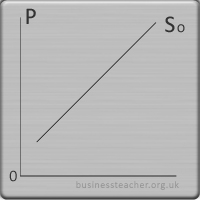
Figure 2. Supply Curve
Since both supply and demand are dependant on the price, the equilibrium market price of a good, according to supply and demand, is indicated by a point where customer demand and producer supply intersect each other. This is called the law of supply and demand. At this point the quantity supplied equals quantity demanded (See figure 3).
Equilibrium
The equilibrium market price (point of intersection of Supply and demand curve) is represented by EQ. PE represents the equilibrium price and equilibrium quantity is represented by QE. In case the price for a good is below equilibrium, the demand for the goods becomes higher than the capacity of the producers to supply the same. In such a scenario a shortage of the goods occur. As a result the price for the product increases until it reaches equilibrium. In case the price for a good is higher than equilibrium, there is a surplus of the good. In such a scenario, to eliminate surplus producers are forced to lower the price. The price falls until it reaches equilibrium.

Figure 3. Equilbrium