
Introduction
When the pipeline in Titusville, Pennsylvania lined the bore holes to allow deeper drilling in the mid-19th century (https://www.bbc.com/timelines/zqgxtfr), a brand-new industry began. It came at a time when emerging technology created new products from oil. The first commercially viable oil well Titusville, as well as the high demand for kerosene, triggered an oil rush in a global scale.
Today, oil and gas are used widely in modern life. Oil fuels the cars, trucks and planes that support modern economies and lifestyles. By-products from oil refining are used in producing plastics and chemicals. Nearly all pesticides and many fertilisers are made from oil or oil by-products. Gas provides electricity and is also used for cooking, heating and fuelling numerous industrial operations. There is no doubt that oil and gas are the cornerstones of modern society.
However, with the diminishing number of conventional reservoirs and increasing concern of the rising global temperature, scientists started wondering if oil and gas will remain our primary energy resource in 30 years. In this essay, we are going to examine the amount of remaining oil and gas reservoirs, unconventional production methods and their costs, as well as current renewables’ situations and costs.
Conventional or unconventional
Oil and gas typically began with a mixture of fine sediments such as silt and clay, combined with organic remains of aquatic microorganisms called plankton. This organic mud can accumulate across wide areas offshore or on lake bottom where plankton is abundant. If the organic mud is covered by another type of rock, it turns to organic shale overtime. When organic shales are deeply buried underground and exposed to the increasing levels of Earth’s heat, organic matters begin to convert to oil and gas.
Shale that has formed oil and gas is called source rock. The tight pattern in source rock structured by tiny silt and clay grains makes the rock nearly impermeable. For this reason, it has been long thought that it is impossible to drill hydrocarbon directly from source rock.
Geoscientists found that natural geological structure could create oil and gas reservoirs, from which we could easily extract. Deeply buried rocks layers are deposits in an aquatic environment, where it still has water rather than air between rock grains. Hydrocarbon is lighter than water, therefore when oil and gas escape from the source rock and encounter porous and permeable rocks (also known as reservoir rocks), such as sandstones and limestones, buoyancy forces the oil and gas upwards through the pore spaces. When oil and gas reach another impermeable layer that blocks the upward migration, they will move laterally along the layer boundary towards a trap-like structure where they begin to accumulate. Traps are normally created by folds and faults, and antiform is the most common natural trap. This type of trap is called the conventional oil and gas reservoir.
To produce hydrocarbon, a vertical well is drilled straight from the surface to this highly concentrated region. The International Energy Agency’s (IEA) defines conventional oil as “a category that includes crude oil – and natural gas and its condensates.”
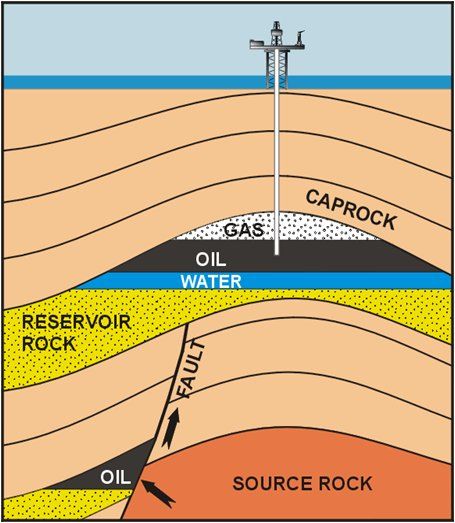
Figure 1. A cartoon demonstration of oil and gas reservoir geology and trap environment. The bright orange-coloured layer is the source rock, the yellow dotted layers are reservoir rocks (typically sandstones and limestones with high porosity and permeability level), and the peach-coloured layers are caprock with low porosity and permeability so that oil and gas cannot escape. The cartoon shows two different trapping environments: fault on the bottom left and antiform at the top.
(https://i.pinimg.com/736x/eb/33/1e/eb331eeb5eb5fa28a4015aea20fab4ed–oilfield-life-oil-industry.jpg)
When the world thought that we had hit the peak of oil and gas production in the 2000s and that we had to focus on developing alternative renewable energies, newly developed technology to extract unconventional reservoirs made the production of shale gas in the US jumped from 1% in 2000 to over 20% by 2010. (https://www.chathamhouse.org/publications/papers/view/185311) This rapid growth, predicted to by the US government’s Energy Information Administration, is going to continue that 46% of the US’ natural gas supply will be provided by shale gas. There is no doubt that the unconventional oil and gas exploration will continue to grow globally with the growing technology.
Unconventional drilling produces hydrocarbons directly from source rock layers or tight rocks (poor quality rock layers that contain migrated oil and gas) through horizontal wells. Although there is still an on-going debate on the precise definition of unconventional oil, in this essay we use the definition made by the IEA World Energy Outlook (WEO) in its 2011 report: “[u]nconventional oil include[d] extra-heavy oil, natural bitumen (oil sands), kerogen oil, liquids and gases arising from chemical processing of natural gas (GTL), coal-to-liquids (CTL) and additives.(https://www.iea.org/publications/freepublications/publication/WEO2011_WEB.pdf) Unconventional oil and gas are harder and more expensive to exploit, however, due to the increasing demand of oil and the continuous shift from coal to natural gas in electricity production, companies and governments have invested heavily in developing unconventional drilling methods.
The most typical unconventional drilling method is the implementation of horizontal wells. They are drilled vertically downwards until reaching the target source layer and curve into a horizontal direction which runs a long distance laterally to give the wellbores extended contact with the formation. The advantage of horizontal wells is the long and constant exposure to source rocks. For example, a vertical well piercing a 30m-thick layer would only have 30m of exposure to the oil and gas interval, whereas a horizontal well would have several hundreds of exposures.
Figure. The cartoon shows the difference between conventional (right) and unconventional (left) drilling methods. The branches extended on the horizontal well are the representatives of hydraulic fracturing.
https://www.croftsystems.net/oil-gas-blog/conventional-vs.-unconventional
Hydraulic fracturing, commonly known as fracking, further extends the drainage pattern around horizontal wellbores by creating fracture patterns that facilitate flow. Fracking injects a high-pressure ‘fracking fluid’ (primarily water, sand and chemicals) into a wellbore to create cracks in the rock formations which release the oil and gas inside. (https://ec.europa.eu/jrc/en/publication/eur-scientific-and-technical-research-reports/overview-hydraulic-fracturing-and-other-formation-stimulation-technologies-shale-gas-0) This method is now widely used world-wild, ensuring the US and Canada to have constant gas supply for 100 years and has presented an opportunity to generate electricity at half the CO2 emissions of coal. (https://www.bbc.co.uk/news/uk-14432401)
Steam-assisted gravity drainage (SAGD) is another method used to open up large deposits below the surface and produce heavy crude oil and bitumen. It is an advanced form of steam stimulation in which a pair of horizontal wells are drilled into the oil reservoir, one a few meters above the other. High-pressure steam is continuously injected into the upper wellbore to heat the oil and reduce its viscosity, causing the heated oil to drain into the lower wellbore, where it is pumped out.
Similar to fracking, SAGD consumes large quantities of water and natural gas – 20 times more than conventional oil drilling, which makes it very expensive to operate. A possible alternative would be cyclic steam stimulation (CSS) and high-pressure cyclic steam stimulation (HPCSS). (https://en.wikipedia.org/wiki/Steam-assisted_gravity_drainage)

Oil and gas in the Arctic
Among the greatest uncertainties concerning future energy supply is the volume of oil and gas remaining to be found in high northern latitudes. According to the United States Geological Survey (USGS), there are about 30% of the world’s undiscovered gas and 13% of the world’s undiscovered oil may be found in the Arctic Circle. The recent retreat of polar ice makes petroleum exploration and development much easier.
Petroleum is highly associated with sedimentary rocks. The map provided the basis for defining assessment units (AUs), which are mappable volumes of sedimentary rocks that share similar geological properties. The Circum-Arctic Resource Appraisal (CARA) defined 69 AUs, each containing more than 3 km of sedimentary strata, the probable minimum thickness necessary to bury source rocks sufficiently to generate significant oil and gas.
(https://pubs.usgs.gov/fs/2008/3049/fs2008-3049.pdf)
Figure. Map showing the AUs of the CARA is colour-coded for mean estimated undiscovered gas. Only areas north of the Arctic Circle are included in the estimates. Black lines indicate AU boundaries.
Out of all 49 assessed AUs, CARA found that over 70% of the oil is concentrated in just 5 of them: Arctic Alaska, Amerasia Basin, East Greenland Rift Basins, East Barents Basins, and West Greenland-East Canada. Over 70% of the undiscovered gas is estimated to be in 3 provinces: the West Siberian Basin, the East Barents Basins and Arctic Alaska. The total mean undiscovered conventional oil and gas are estimated to be approximately 90 billion barrels of oil, 1,669 trillion cubic feet of natural gas, and 44 billion barrels of natural gas liquids.(https://pubs.usgs.gov/fs/2008/3049/fs2008-3049.pdf) This amount of resources is equivalent to 403.24 billion barrels of oil and would last for at least 13 years at current assumption rate. With such high concentration, it is easy to operate the mass production of petroleum once the technology is mature.
The increasing possibility of producing hydrocarbon in the Arctic makes the amount of fossil fuel left on the Earth more unpredictable. “It is no longer plausible to assume that the stock of future oil reserves is known, that it is limited to the conventional wells, and that there is a limit of around 100 -110 mbd (million barrels per day) in production that cannot be exceeded. … It is just a question of cost, price and whether it is worth investing in the technologies to get them out. … The problem is peak carbon: there is too much oil and gas left, as well as the vast coal deposits.” quoted from Burn Out.
Renewables
To substitute oil and gas in the energy sector, renewables are growing at an unprecedented pace. According to British Petroleum (BP) 2018 energy outlook, renewable energy is increasing its market share within the power sector at a rate of 7.5% per annual, accounting for over 50% of the growth in power generation. (https://www.bp.com/content/dam/bp/business-sites/en/global/corporate/pdfs/energy-economics/energy-outlook/bp-energy-outlook-2018.pdf)
Solar energy is one of the most widely used and best-developed renewable energies. When sunlight is absorbed by solar panels, the solar energy knocks electrons off from the atoms, allowing the electrons to flow through the material and produce electricity. This process of converting light (photons) to electricity (voltage) is called the photovoltaic (PV) effect. (http://www.chemistryexplained.com/Ru-Sp/Solar-Cells.html)
Solar energy is effectively infinite. The Sun’s energy is so abundant that more energy is transferred to our planet in an hour’s sunlight than the entire global electricity consumption for a year (https://books.wwnorton.com/books/The-Great-Transition/). It is also one of the fastest expanding renewable energy sources. With quicker technical gains and stronger policy support, the price of solar power is dropping rapidly.
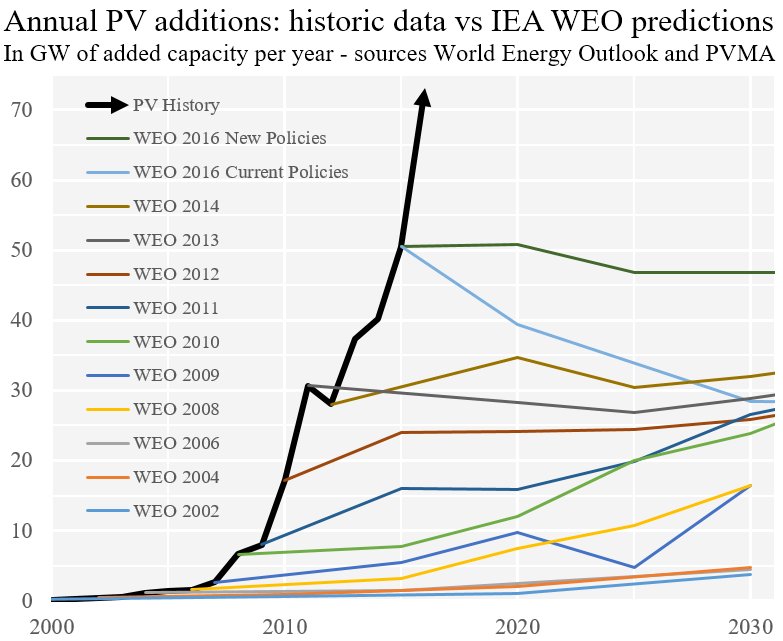
Figure. Annual photovoltaic addition history versus International Energy Agency (IEA) World Energy Outlook (WEO) predictions from 2002 to 2016. The graph shows exponential growth in solar energy capacity and a continuous underestimation by WEO.
https://2oqz471sa19h3vbwa53m33yj-wpengine.netdna-ssl.com/wp-content/uploads/2017/05/iea-predictions-solar.jpg
Figure. In the Evolving Transition scenario (ET scenario), which is premised on a demand for fossil fuels that vastly exceeds the carbon budget for limiting temperature rises to 1.5-2C, solar cost continues following its learning curve. The module cost falls by around 24% with every doubling of cumulative capacity. The rate of decline slows down in the BP 2018 Outlook, as it takes longer to double the cumulative capacity later on the learning curve.
However, there are still unsolved issues in using solar power. We are currently only capable of harvesting a small part of the light spectrum. We harvest the visual light spectrum while the IR and UV sunlight comprise, respectively, 47% and 46% of the light spectrum. The problem now is that how to open up from the current 7% through more efficient solar panel materials and mechanisms.
Solar energy is intermittent, and so are wind and tidal power. We could not get 24/7 access to these kinds of renewable energy. Without a cost-effective large-scale energy storage system, renewables will never take over oil and gas in market share. Although researchers and companies have been working on developing stationary energy storage, there are no existing solutions, which is low cost, reliable, environment-friendly, well-developed with a proven track record, to this problem.
Conclusion
The core message we learnt from the research is that: oil and gas will still be our major energy source for the next 30 years because of the developing technology in extracting unconventional reservoirs, continuous researches in Arctic reservoirs, and high-cost and intermittent renewable energies.