
If we dig into the history of the United States of America, it is obvious that every story is filled with wars. During the war period, the propaganda act played an initial role to motivate the soldiers in war. Propaganda was the main strategy to win or lose the war. The propaganda was always being very helpful during the war in the United States of America. During the war, Numerous nations depended on propaganda for a couple of reasons for example: conveying the message to the citizens of the nation, motivating the soldiers, requesting the individuals to join the armed forces, leading to the better consequences. This act was done by various methods like print media, digital media etc. The advertisement I have selected is based on war propaganda published via print media. The poster includes a Text (logos) an image (Ethos) and the Audience (Pathos). In 1942, the food was scarce and not enough to feed the soldiers, the military needed more food to feed the soldiers for that reason grocery stores started rationing of canned food as a solution. The poster was a reminder for the civilians, not to waste food and try to consume less food on the home-front so that the soldiers would have the provisions and food they needed.
Source
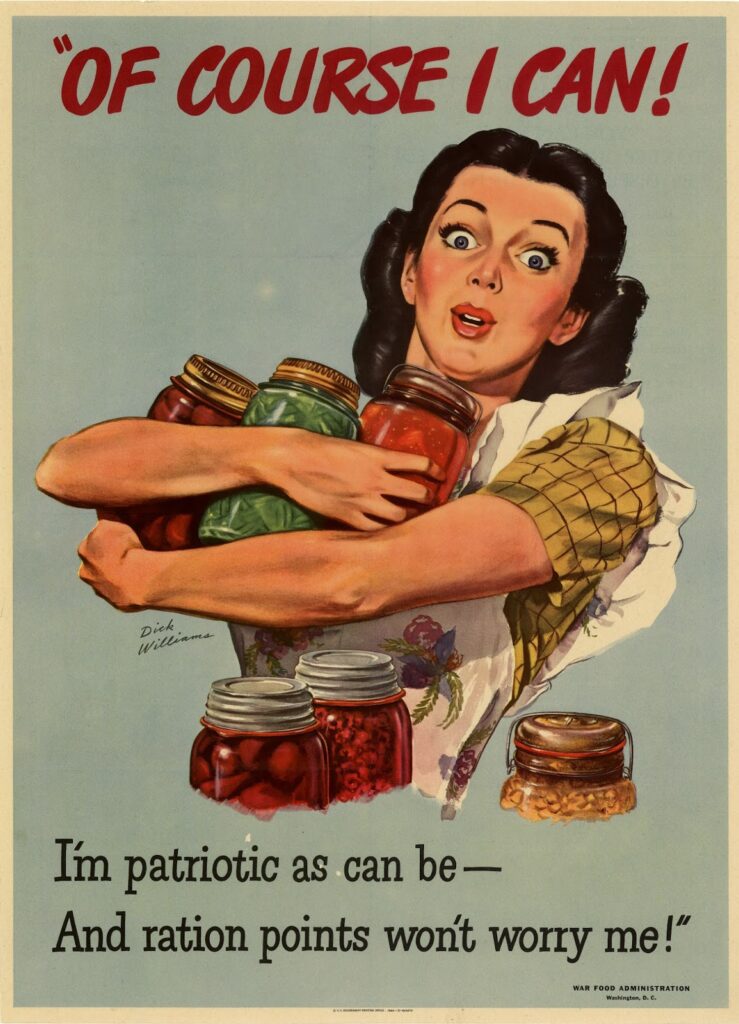
After the World War II ended, the War Food Administration circulated a rationing poster named “Of course I can!” The poster had a picture of a young woman holding food cans, she confidently explicates “I’m Patriotic as can be”, further she says “And ration points won’t worry me.” The woman shows the contribution by saving food and it doesn’t matter to her if she gets less ration points. During the war, canned food became an essential need for many civilians because of the shortage and rationing of food. The young woman shows her patriotism by saying “I can” while staying at home. Her “I can” spirit determines the ability of women contributing to war while staying at home. Alongside, she is confident that she is also serving the nation and play an important part in the war. The government declared the women caretaker of food.
A visual image of the poster shows a very beautiful young woman who is wearing a house dress along with an apron. Each hair is shown in the right place and her red blushed cheeks illustrate that although she spends her time working in the kitchen but she still manages her femininity. Furthermore, the poster shows that the woman is holding jar containing vegetable and pulses. Despite the tension of war, her peaceful expressions describe her satisfaction in the matter of fact that she has not stayed behind in the crucial time of war. War Food Administration has targeted housewives for this advertisement as their audience because women are the one who takes care of their family and they are the one who can provide better for their family in rough times if motivated by the emotional and powerful propaganda. This poster contains a message for the woman who does not fight in the Warfield but she can still be patriotic by saving the food for her kids and her husband and for the soldiers who fight on the battlefield.
Although the text of the poster is powerful but it is still vague. It claims that a woman can only be patriotic is by saving food and ration points. As the poster was published during the war, the chosen emotional fallacy is used to provoke the domestic women to achieve the motif. Throughout the war, the government needed more people to join the army, the war food administration preserved the image of women as a homemaker in the wartime. Though the message seems to contradict because at one point women were empowered by showing the patriotism and on the other point she is discouraged and objectified to stay in the kitchen. It was shown that taking care of her husband and her children is the only way to be patriotic. Instead of encouraging what women can do in the factories while their husbands are at war, they are ordered to stay at home.
The war food administration gained the attention by advertising a young, beautiful woman who shows her patriotism by saving food for soldiers. Although Ethos, pathos, and logos gave feelings and colors to this advertisement yet a chosen emotional fallacy is exploited to gain the sympathy. To guarantee as much contribution as possible, the government and the media showed a woman as an example of a housewife who not only is beautiful but willing to do anything for the sake of her homeland. Portraying a conservative approach towards women drew the traditional gender line between male and female. Though woman could not fight in the war directly, but she still played her part by staying at home with the kitchen as the battlefield and food as her weapon. The passion and devotion for the task was an example of true patriotism. She understood her role in the war still she willingly carried out her duty with enthusiasm.